


Electric Ridesharing in Hamburg: MOIA’s Smart Mobility Concept
Energy for Ridesharing
Since April 2019, the Volkswagen offshoot MOIA has offered ridesharing with electric vehicles in Hamburg. The concept relies heavily on the High-Power Charging Solution developed by Porsche Engineering.
It’s raining slightly in Hamburg. The MOIA vehicle will be at Heidi-Kabel-Platz in front of Hamburg Central Station in three minutes, the app says. “Almost there!” the app suddenly announces—and there’s MOIA 181 turning onto the plaza already. The driver keys the door and greets us, introducing himself as the door glides smoothly open. Inside, a pleasant ambiance awaits us: everything is spacious and smartly lit. Cheerful colors, off-white, golden side paneling, the seats are a light shade. A car that’s not just functional, but that’s also out to offer its passengers an enjoyable ride.
There’s another passenger in the car already, gazing intently at their phone. They hop off a couple minutes later. We drive on. Outside, Hamburg drifts past; we catch a glimpse of the Alster river. Inside, there’s not so much as a hint of the city’s traffic noise, and no engine noise either. MOIA moves through Hamburg strictly on electric power.
But that’s not the only thing that's special about this Volkswagen subsidiary. Compared with the city’s public transport on the one hand and taxi companies on the other, MOIA takes a different approach to business, too: MOIA serves the needs of different kinds of passengers, positioning itself midway between the scheduled departures of buses and trains and personal travel as offered by a taxi. When we use MOIA, we feed our transport wishes to an app and get picked up at the desired time from one of the many virtual stops scattered in close proximity to one another.

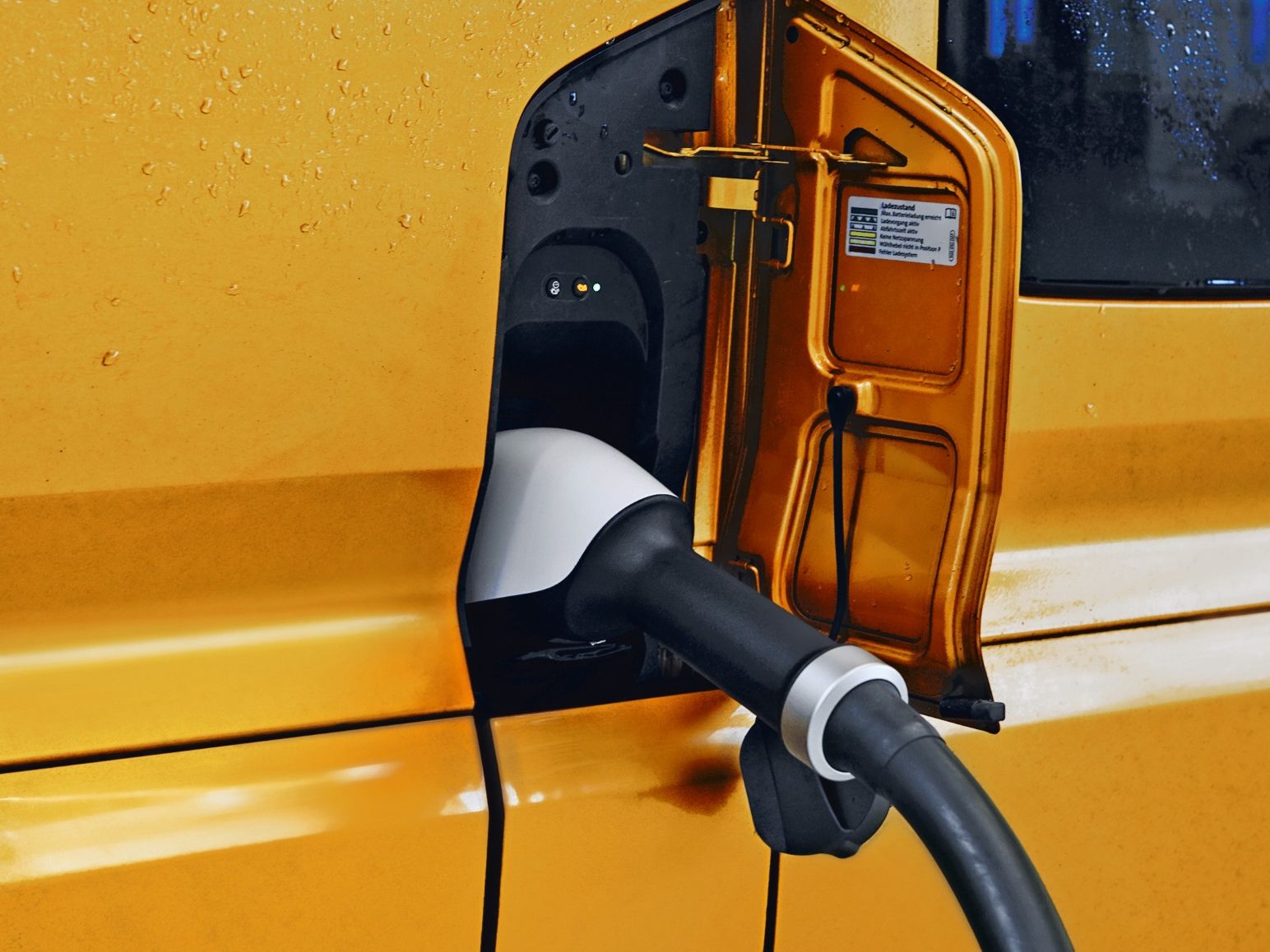
High-Power Charging: It takes 20 to 30 minutes for the people carriers to charge for 300 kilometers of driving.
Efficient Urban Transport
While traveling from our starting point to our destination, other passengers can get on or off, which reduces the number of vehicles needed. These stops on the way can make the trip take longer, of course. The idea is called ridesharing. Smart software keeps the MOIA fleet operating at optimum capacity. MOIA primarily targets the daily commutes, aiming to merge traffic flows for greater efficiency. In Hanover, MOIA already took to the roads in 2018. We can catch them in Hamburg since spring 2019.
A trip with MOIA costs more than public transport but less than a taxi fare. We pay cashless, through the app. We can tip the driver and leave a rating, too. The vehicles themselves were designed specially for MOIA by Volkswagen under the project name Pluto. They are people carriers based on the Crafter, six meters long and two-and-half meters wide. They offer a ride for up to six passengers. By the end of 2019, 500 of them will be on Hamburg’s roads.
By now, MOIA 181 has turned the corner onto Grindelallee, moving with the traffic. Every now and again, we pass another MOIA transport. The new concept is gaining in popularity. No surprise, as the city’s roads are congested with cars, buses, and taxis, all packed into tightly flowing traffic. Estimates predict that personal motor traffic hasn’t even peaked yet. Apparently, despite Germany’s declining population, the number of personal motor vehicles is expected to rise by about ten percent over the next few years. Especially because the older demographic is becoming more “automotively mobile.”
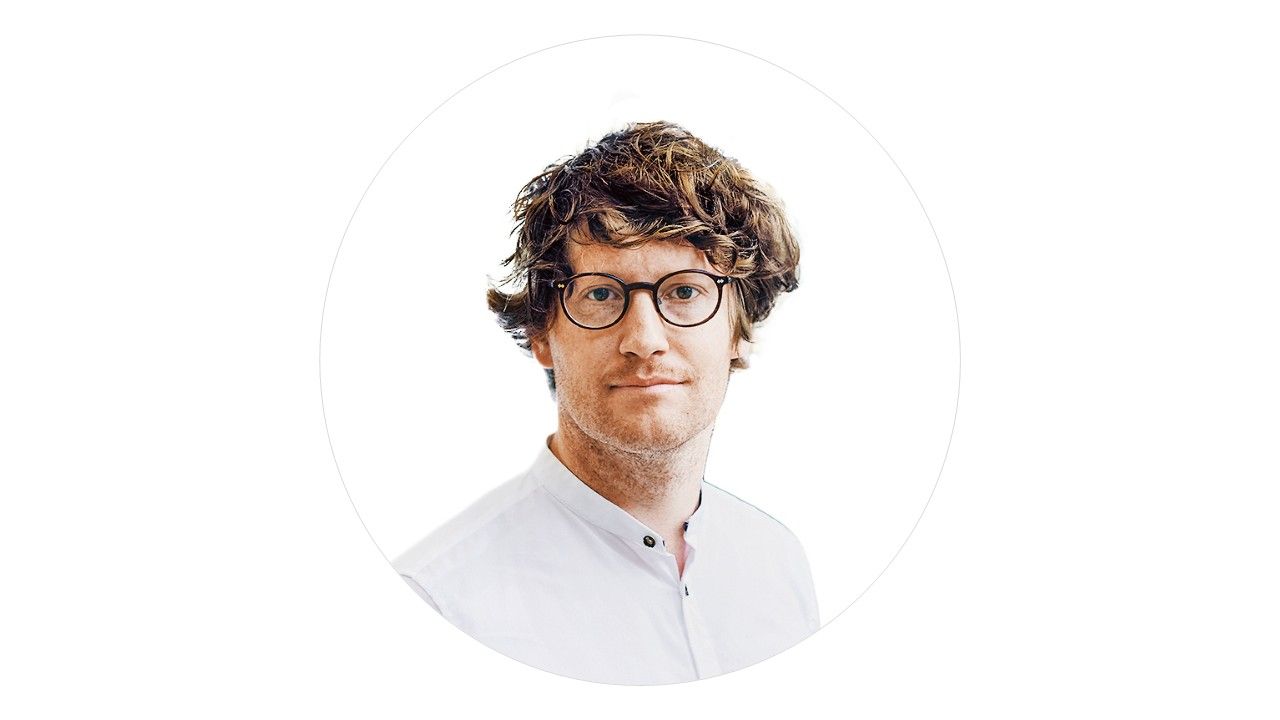
“We charge each vehicle we’re actually running three or four times a day.”
Dr. Christian Matt
Management Consultant with MOIA Operations
Urban infrastructures are already beginning to struggle today. While action is being taken to divert or reduce traffic—investments in public transport, experiments in using carsharing or other mobility concepts, a rise in new modes of transport like e-scooters and e-bikes—none of this will be able to stem the tide of growing mobility. Cities and regions need to explore new ideas to cope with the predicted boom.
Hamburg, too, is investigating new types of mobility. In Germany, Hamburg takes top spot when it comes to the proliferation of electric car chargers. Together with Hanover, Hamburg has also wasted no time in testing—and proving—MOIA's ridesharing approach. Many other towns and cities today offer comparable services. But MOIA intends to become the market leader, with plans to expand to more places already being made.
The company and its vehicles have covered the city’s entire area with a tightly woven web of many thousands of virtual stops. MOIA wants to push further outwards beyond the city bounds. The idea is to guarantee that we never have more than 250 meters to walk before we reach a pick-up point anywhere in the company’s 200-square-kilometer business range. “We’re still setting up,” says Jens-Michael May, CEO of MOIA Operations. “But once we start operating all over the greater Hamburg area, the economies of scale of a major transit system begin kicking in.”
500
18
2,000
Hoheluft, Eppendorf, Niendorf: MOIA 181 has reached the depot at Niendorfer Weg 11. The unadorned hangar is bustling. Vehicles are driving in, drivers getting out and hooking up the MPVs to the chargers. At the time of writing, there are 200 vehicles operating round the clock; every week sees new ones arriving to expand the web. Business only shuts down Tuesdays and Wednesdays, from one a.m. to seven a.m., when passenger numbers are very low—an opportunity to run checks on the vehicles.
For everyday operations, it’s essential that the vehicles can be charged whenever required. To charge them, MOIA uses 120 conventional AC chargers on the outdoor area of their depot. These take seven hours to fully charge the vehicles’ batteries. Additionally, there are eighteen High-Power Chargers in the hangars for use during round-the-clock operation. These cutting-edge power plants run 400 volts into an MPV’s 87-kilowatt-hour battery to fully charge it in twenty to thirty minutes. Enough to cover 300 kilometers.
The fast-charging infrastructure was devised by Porsche Engineering. “Our charger solutions offer MOIA three key benefits,” Tim Munstermann tells us. He’s in charge of project management and high-voltage systems with Porsche Engineering. “They take up little space, which makes them good for depots where space is an issue. They’re also really easy to expand. And finally, they’re more efficient compared to what competitors offer.”

Powerhouse: The High-Power Chargers from Porsche Engineering supply 150 kilowatts.
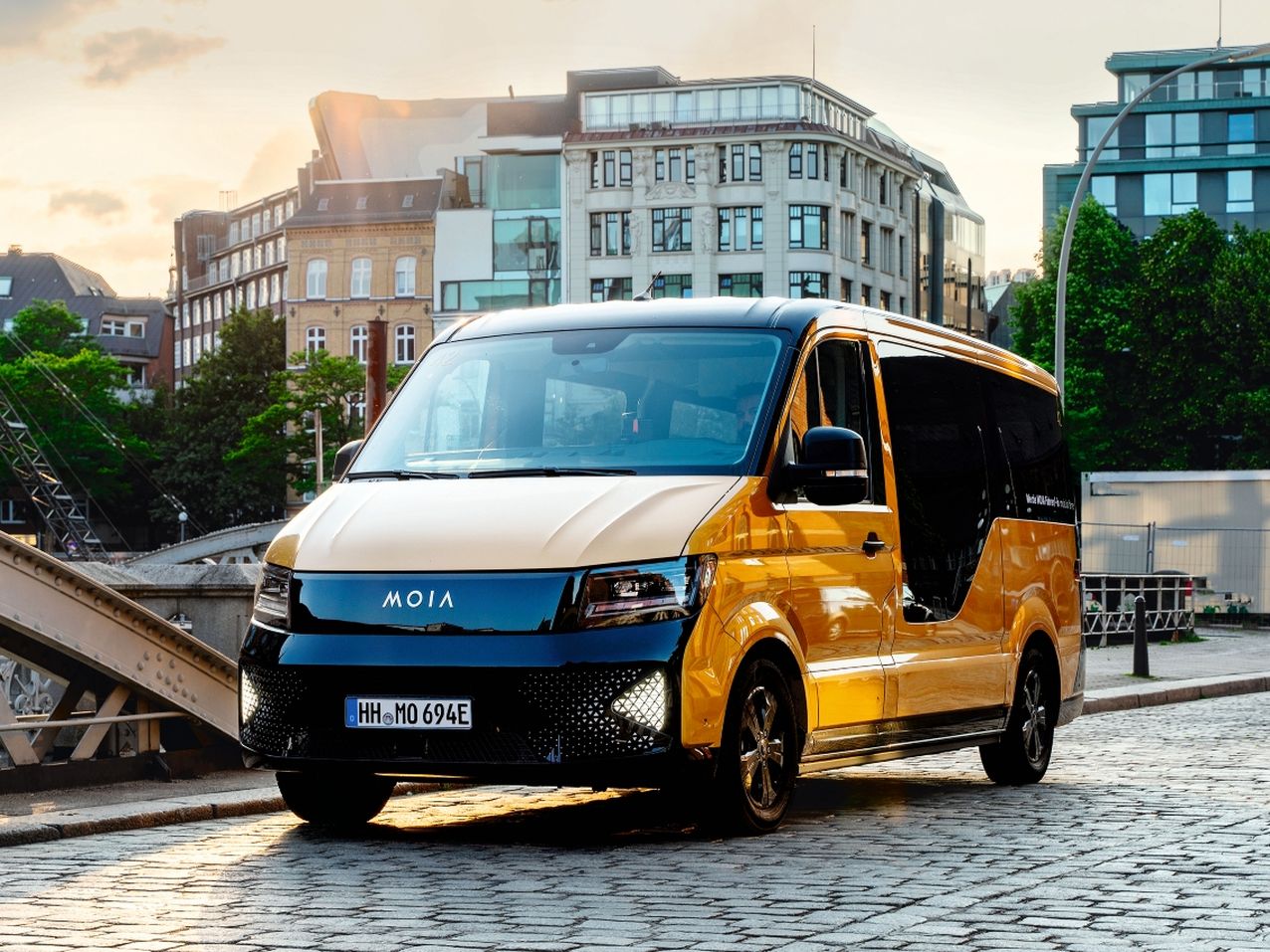
Specially Designed: Volkswagen developed MOIA’s vehicles based on the Crafter.
Important Findings from Practical Application
Porsche Engineering is getting something out of MOIA using the chargers, too: the use of the charging solution is a valuable validation of the overall system’s performance under continuous, high-load operation. The chargers are kept running 24/7, rain or shine. An important source of data, as the weather affects energy consumption and charge cycles: rain alone increases the vehicles’ electricity consumption by fifteen percent; extreme temperatures of below minus ten or above thirty degrees Celsius affect operation even more severely. For Porsche Engineering, such data provides valuable information for improvement as well as further developing the Charging Solutions.
The power supply as a whole is also under pressure to adjust to the requirements of electric mobility. A high volume of electricity needs to be generated, renewably, and supplied to the vehicles. MOIA keeps this in mind, choosing locations for their depots not only based on where the city still offers space. The proximity to one of the medium-voltage circuits that supply all of Hamburg is also important. Porsche Engineering assisted MOIA in finding the right location, as getting the technical systems officially approved by the medium-voltage grid’s operator is especially complicated.
Sustainable: MOIA currently purchases eight megawatt-hours of renewable energy a day from a Hamburg supplier.
MOIA currently purchases eight megawatt-hours of renewable energy a day from the Hamburg supplier Stadtenergie. “We charge each vehicle we’re actually running three or four times a day, that’s two thousand rapid-charge ops a week,” says Dr. Christian Matt, management consultant and responsible for charging technology at MOIA Operations. “We maintain fine-tuned load management and control current consumption to prevent our charging the vehicles from causing hazardous grid voltages.”
To ensure that the chargers remain constantly in use, MOIA also sets up shift schedules one month in advance and offsets the workforce’s three shifts by a couple minutes. This way, there’s always a vehicle ready to leave the depot, merge into the passing traffic, and pick up the next lot of passengers for their shared ride.
In Brief
MOIA intends its ridesharing concept to revolutionize urban traffic. They run a fleet of electric MPVs. Frequent recharging is indispensable to putting the vehicles to optimum use. Porsche Engineering’s charger technology ensures that “refueling” takes up as little time as possible.

Loves Ridesharing: Jens-Michael May wants to do good by Hamburg.
“We’re considering a grander scale”
Jens-Michael May is MOIA Operations’ CEO. He tells us what the company does differently from other mobility services.
Mr. May, new mobility concepts are a hot topic. What’s special about ridesharing and MOIA?
Tomorrow’s mobility will comprise a whole range of elements. MOIA’s ridesharing is a sound supplementation of the existing modes of transport. We merge traffic and motivate commuters to travel together. This reduces urban traffic and its environmental impact. What sets us apart is that we're considering a grander scale, planning a major transit system: we want to have around one thousand vehicles operating in Hamburg in the next three years, to handle roughly one percent of the total traffic volume. As a reference: the Hamburg metro alone moves two-and-a-half million people every day. So one percent of that isn’t bad.
Will your idea also fly in megacities in Asia, Africa, or Latin America? And how long until MOIA’s MPVs drive themselves?
Large cities are where ridesharing really comes into its own. The larger the city, the more fully the vehicles’ capacities are utilized. Megacities benefit from major economies of scale. Ridesharing is only one element in a town’s or region’s mobility mix. But it’s a highly efficient one because it supplements the other modes of transport. It’s likely to be years yet before we have self-driving vehicles. For now, we need to demonstrate that MOIA, that ridesharing actually works. And driverless cars aren’t only a technology issue, they’re a social one, too.
How important is Porsche Engineering’s charger technology for MOIA?
We naturally depend heavily on our ability to reliably charge our vehicles whenever we need to. That’s why we chose the technology supplied by Porsche Engineering. On the one hand, it’s definitely an advantage to have cutting-edge tech, because it’s highly economical. On the other, the technology is excellently suited for our depots because it’s really simple to expand in time with MOIA’s growth and only takes up very little space. These are crucial aspects for the urban locations of our depots.
Info
Text first published in the Porsche Engineering Magazine, issue 2/2019.
Text: Axel Novak
Contributors: Tim Munstermann, Andreas Rau
Photos: Martin Kess, MOIA
Copyright: All images, videos, and audio files published in this article are subject to copyright. Reproduction in whole or in part is not permitted without the written consent of Porsche Engineering. Please contact us for further information.
Contact
You have questions or want to learn more? Get in touch with us: info@porsche-engineering.de