

)
X-BOW Evolution: Automatic Transmission for Pure Speed
Successful Marriage
Since 2018, the X-BOW from KTM has also been available with an automatic transmission. Porsche Engineering was responsible for the calibration. Among the challenges: Specified components had to be persuaded to work together. In the end, the X-BOW and the double-clutch transmission proved a perfect couple.
Anyone who has seen it won’t soon forget it: The X-BOW from the Austrian manufacturer KTM is an unusual vehicle. The company from Mattighofen im Innviertel is actually better known for its motorcycles—yet since 2008 KTM has also been active in four-wheel motorsports with the limited X-BOW series. With its unconventional design, the roadster quickly built a devoted fan base, and is also available in a street-legal version. But it doesn’t yield its racing character even then: The vehicle dispenses with electronic driving assistance functions such as ESP, and ABS is optional. And of course, the X-BOW is shifted by hand, with a clutch and shift lever at knee level.
At least until recently: Since 2018 the X-BOW has been available with a six-speed automatic transmission as well, which can also be retrofitted. The impetus for this variant came from the sales department. “At presentations in countries such as China or the US, many interested customers had difficulties even driving the car,” reports Jürgen Gumpinger, Vice President for Sportcars at KTM. They had never learned to drive a manual. "This, in turn, meant that an automatic transmission would be needed to market the cars successfully in those regions."
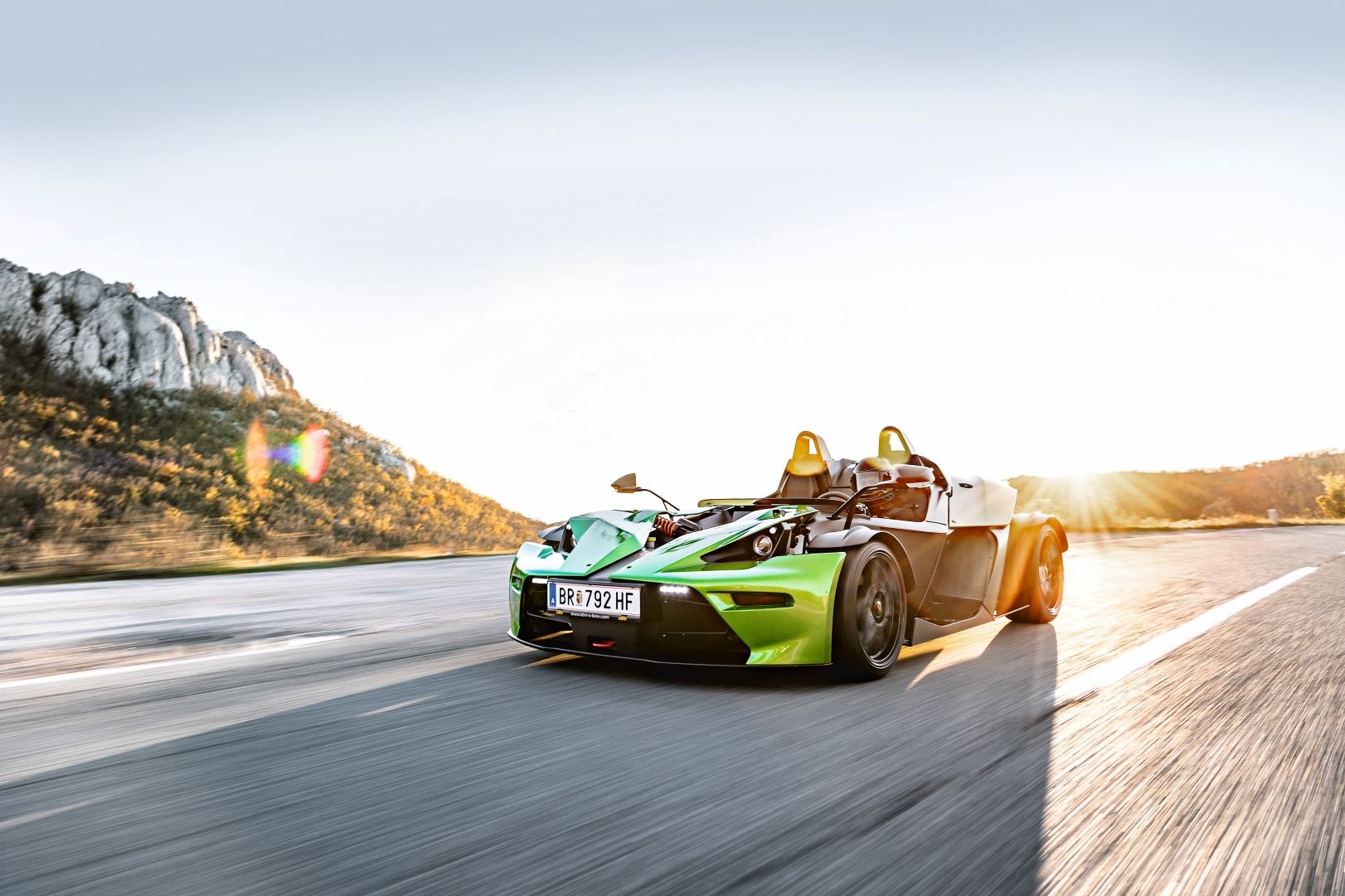
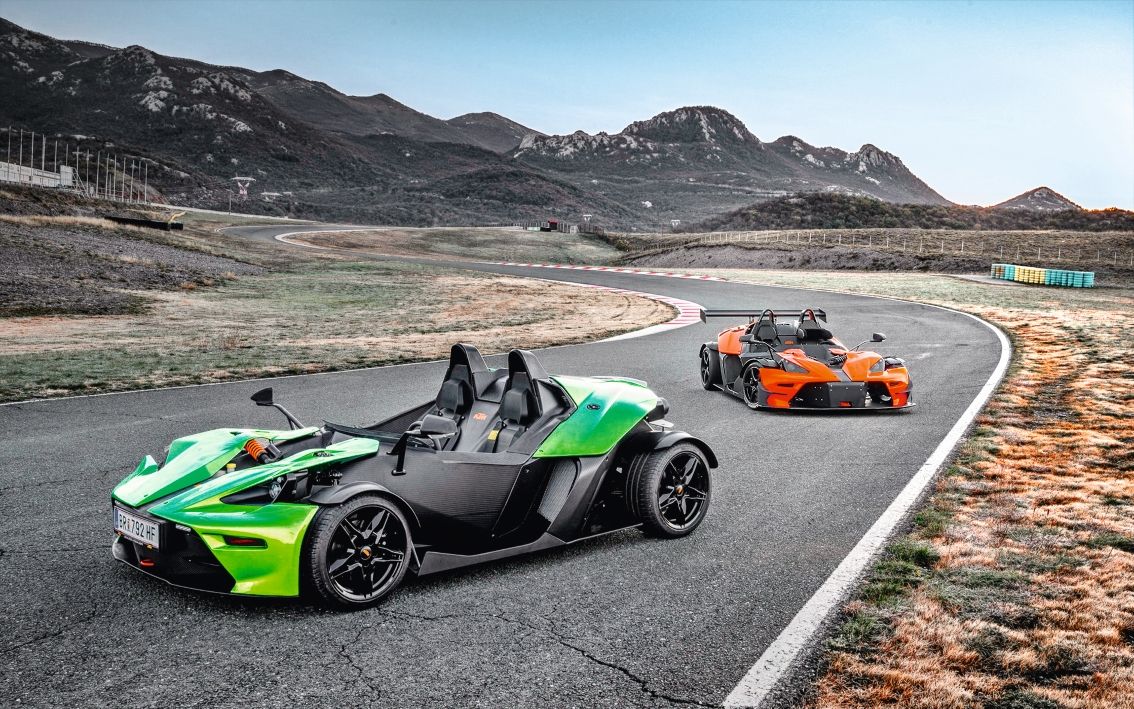
Unmistakable: The X-BOW is a car one doesn’t soon forget.
The company opted for a double-clutch transmission from the VW Group, which under the designation DSG (for direct shift gearbox) became the first large-series-production double-clutch transmission in 2003. In the world of motorsports, the technology had already been developed and successfully used by Porsche in the 1980s. In 2008, the Porsche PDK double-clutch transmission went into series production with the 911 Carrera. Owing to its multitude of experience within and outside of the VW Group, KTM commissioned Porsche Engineering to take on the X-BOW transmission calibration.
The challenge was a daunting one, and not only due to the short timetable. The team was charged with getting the predefined and unchangeable components such as engine, transmission and corresponding control units to cooperate in a new race car. If just a single component didn’t play along, the entire car wouldn’t work. “The trick in such projects is actually to get the new transmission to communicate with the existing control units,” says Dr. Jan-Peter Müller-Kose, Senior Manager Drivetrain Testing at Porsche Engineering. “This electrical integration presented us with significant challenges.” At one point in the project, for example, the horn sounded when the turn signal lever was used. “The goal is for the given components not to even notice that they’re in a different car and for the car ultimately to have the character of a race car through a custom transmission calibration,” says Dr. Müller-Kose, summing up the unusual commission.
231
km/h
1,984
cm³
<
3,9
sec.
Electronic Gear Ratio Assistance
With the small scale of production insufficient to justify a complete redesign, the job called for engineering acumen with the software of the DSG’s controller. The hardware was therefore adopted from series production, but was tapped to do service in a different environment—that is, to react with race-typical gear changes in race-typical driving situations. Moreover, the software was accustomed to data that a vehicle like the X-BOW simply cannot provide. ABS, for example, which normally provides information of the wheels’ rotational speed, is only available as an option. So the search was on for a different way of getting the desired information—naturally in a format that the standard transmission software could understand.
The problem was resolved by means of a gateway, which enabled the information between the components of the transmission control unit, shift lever, and instrument panel of the X-BOW to be exchanged in the correct format. “If you combine different components, the data addressing doesn’t match up,” explains Dr. Müller-Kose. “Furthermore, the measurement values from sensors are in value ranges that the other participants of the system can’t use.”
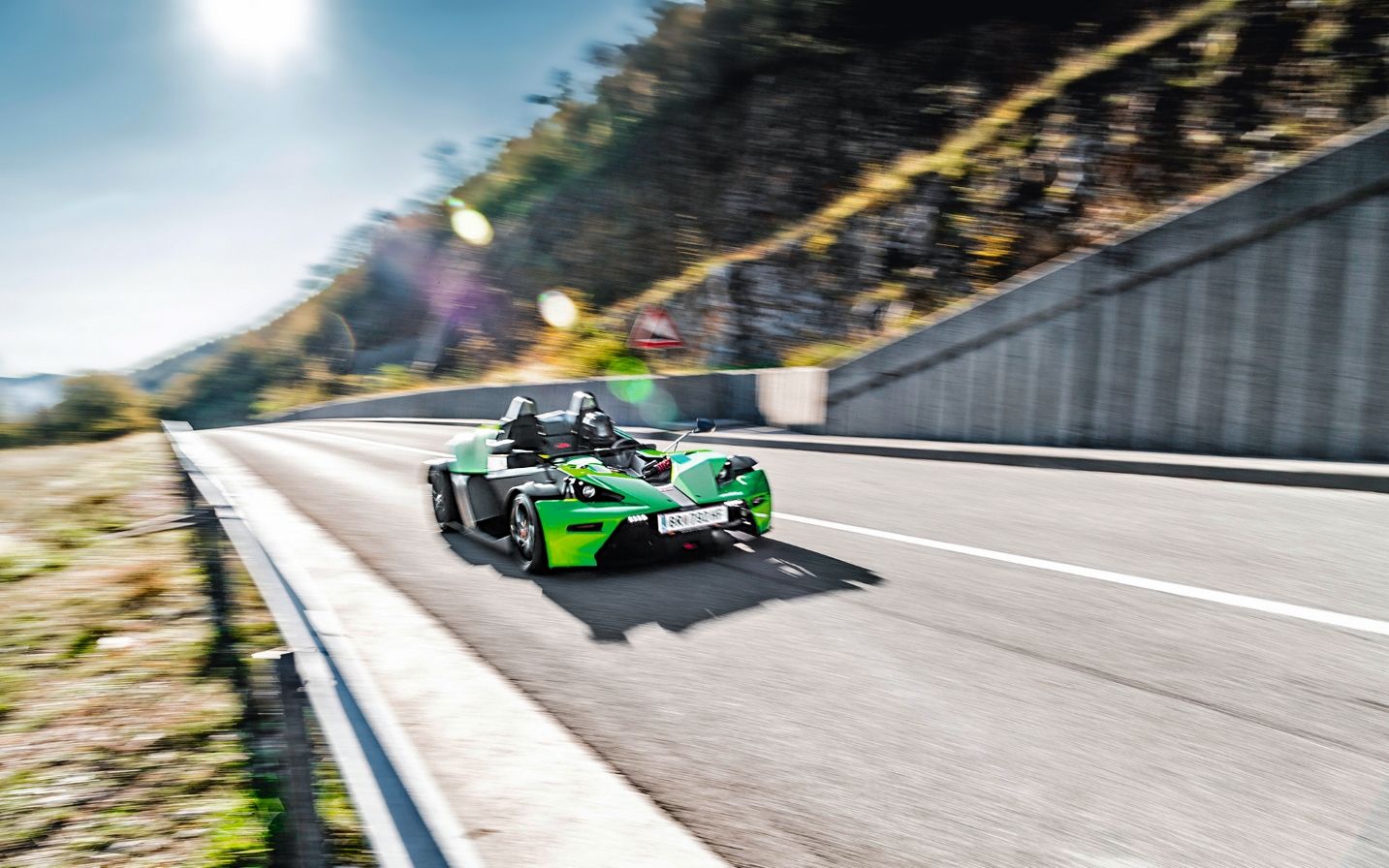

Pure Driving Pleasure: With its striking design, the roadster (shown here in the manual version) quickly gained a following.
Practical Test in Italy
As a rule, in such projects the experts from Porsche Engineering make substantial use of complex development and simulation tools before the practical tests begin. In the case of the X-BOW, however, a “hands-on” approach was taken in view of time constraints, and the prototype came to the track at a very early stage. It quickly became clear that excellent work had been done: The components worked well together and performed their tasks brilliantly. But the prototype passed the real test of its mettle at the Nardò Technical Center in Apulia. “At the Porsche Engineering testing grounds in Nardò, we have a circuit based on the classic race tracks,” explains Dr. Müller-Kose. Only there was it possible to fine-tune the shifting strategy of the transmission optimally for the engine and vehicle handling under race conditions. This, then, was where the final tuning and acceptance were conducted.
“Everyone who drives the car says: That was really fun!”
Jürgen Gumpinger
Vice President Sportcar KTM
The transmission calibration specialists went through their paces, collected measurement data on the track and sent it all to their electrics colleagues in Germany for analysis. For their part, the electrics team was responsible for the electrical integration of the transmission control unit and the shift lever, as well as their networking with the rest of the vehicle. They analyzed, for example, whether the signal exchange functioned properly and the control unit functions worked. They then reported their results back to Nardò. Where necessary, changes were implemented and the results again tested on the track. In this manner the team inched its way forward in iterative loops over a period of several weeks, and ultimately toward the goal of optimized driveability.
Thanks to the switch from manual shifting to the double-clutch transmission, cornering maneuvers now necessitate neither the torque interruption on the rear axle nor a reach for the gearshift lever. The result is higher cornering speeds with better vehicle control. Drivers can keep their hands on the wheel in corners, which allows even less experienced drivers to drive the car with a sportier style at higher speeds without compromising on safety. In the end, all involved were satisfied. Conclusion: The marriage of the X-BOW and the double-clutch transmission was a success. Or as KTM Race Director Grumpinger puts it: “Everyone who drives the car says: That was really fun!”
Info
Text first published in the Porsche Engineering Magazine, issue 1/2019.
Text: Jost Burger
Photos: KTM
Copyright: All images, videos, and audio files published in this article are subject to copyright. Reproduction in whole or in part is not permitted without the written consent of Porsche Engineering. Please contact us for further information.
Contact
You have questions or want to learn more? Get in touch with us: info@porsche-engineering.de
Consumption Data
KTM X-BOW (Sport and Drive)
CO₂ emissions (combined): 288.8–200.9 g/km;
Fuel consumption (combined): 9.8–8.6 l/100 km