


Nardò Technical Center: Future-Ready Automotive Testing
Nardò 2.0
New asphalt, an innovative guardrail system, and a modern IT infrastructure: Porsche Engineering has renovated the Car Circular Track and the Car Dynamic Platform of the legendary automotive proving ground near Nardò in southern Italy. Among other things, the improvements enable high-stress endurance tests under extreme conditions as well as the testing of new vehicle functions.
The big ring is decidedly conspicuous on satellite Timages—it encircles the Pista di Nardò with a diameter of four kilometers. Originally slated for the construction of a particle accelerator, the site was instead turned into an automotive test track by Fiat in 1975. In 2012 the grounds were acquired by Porsche, and since then the Nardò Technical Center (NTC) north of the Apulian coastal city of Nardò has been operated by Porsche Engineering.
After a year of preparation, the construction work stretched from January to July. Over the seven-month period, a total of 420,000 square meters were renovated with 100,000 metric tons of asphalt delivered in 3,125 truckloads. The work also involved the installation of a specially designed, patented guardrail system on the Car Circular Track and established a basis for a digital infrastructure.
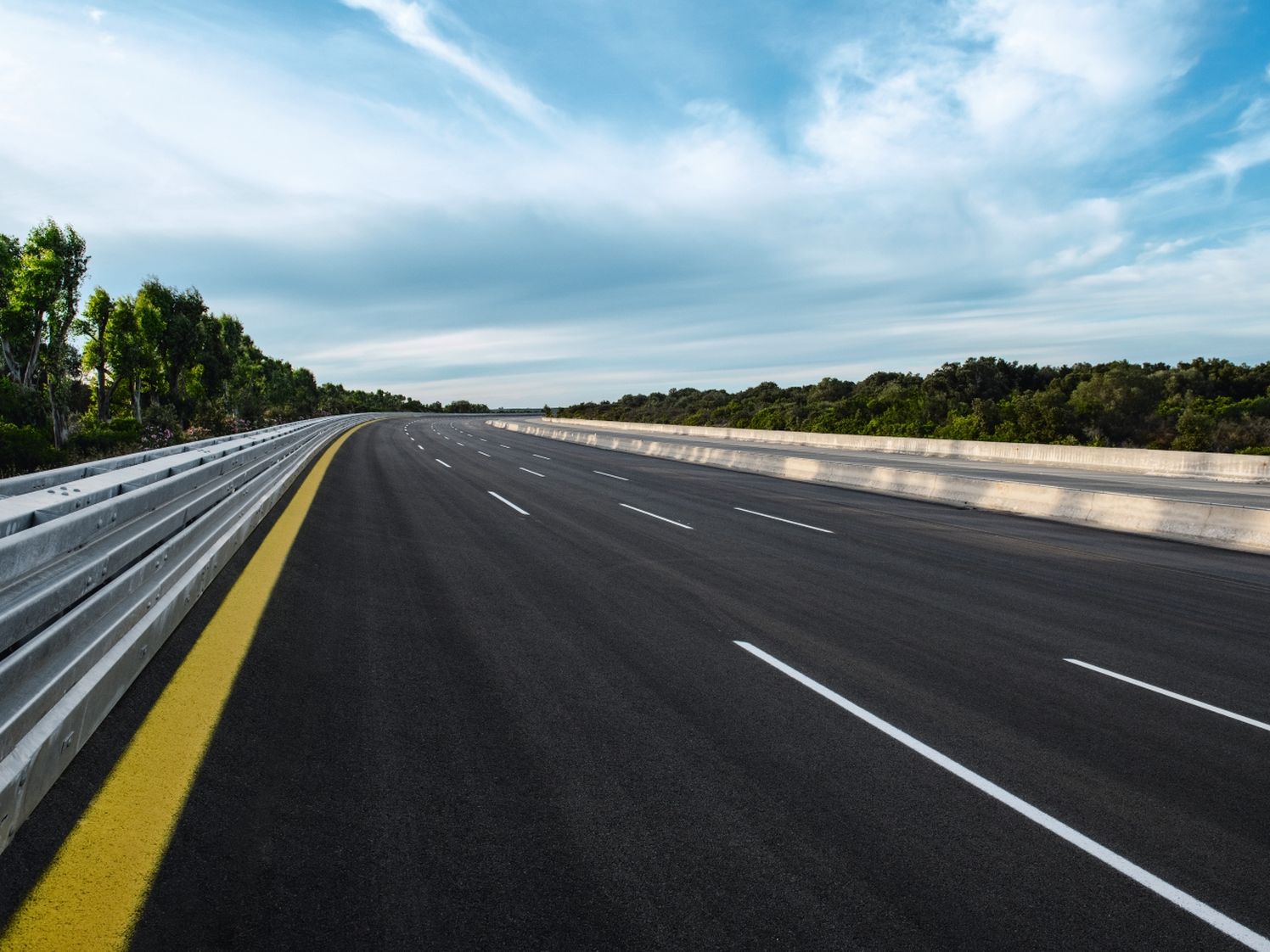
Precision Is the Watchword: The driving surface is extremely smooth, because even irregularities in the millimeter range would be clearly perceptible in the car at high speeds.
The asphalting of the Car Circular Track was a major challenge. “A test track is subject to completely different standards from those that apply in public road construction,” explains Matthias Köstner of Porsche Engineering, who is the project manager for the modernization of the NTC. “On the test tracks at Nardò, vehicles are driven to their very limits, which means that irregularities in the surfaces and friction variations have to be avoided as much as possible.” And then there is the special shape of the circuit. The Car Circular Track in Nardò has four lanes and a parabolic profile. Its incline becomes increasingly steep as it rises—at the top edge, the highest lane has a roughly 25% tilt compared to the ground. This means that drivers can drive at a speed of 240 kilometers per hour without lateral forces. On the lower lanes, the speeds at which the lateral forces do not occur are accordingly lower.
Before the new track surface could be applied, the road building team had to mill the existing surfaces of the track and test various mixtures and compacting programs—the test area alone was over 1,000 square meters in size. To demonstrate the high quality standards of Porsche Engineering, Köstner invited every worker to take a ride in a Porsche 911 R driving at the limit. “Many of them went pale and changed their opinions on the requirements for a perfect track surface,” he recalls.
~
25
%
This was followed by a particularly tricky task: the objective was to apply a homogeneous driving surface to a parabolic banked curve almost 13 kilometers in length—without critical longitudinal and lateral grooves and with a uniform rounding profile all the way up to the top. Meeting this challenge required the utilization of a type of full-width paver of which there are only two in the world. The roughly 100-metric-ton machine spans multiple lanes and moves on caterpillar tracks. The driving surface geometry is configured and fixed using a hydraulically adjustable mounted implement. Per day, the machine requires roughly 1,000 metric tons of material, comprised primarily of crushed rock, sand, and bitumen—the asphalt.
Seamless Asphalt Mat
The material was produced according to a defined recipe in an asphalt mixing plant and transported to the construction site in heavy trucks. The full-width paver distributed the asphalt over the track surface with a conveyor chain and compacted it with vibrating tamper bars. To enhance the quality and durability of the new surface, the hot asphalt was then further compacted with road rollers. The rollers were turned down in line with the planned track profile, and on the higher lanes they were held in place by anchor rollers on the external patrol lane. The new asphalt layers were applied in succession across a width of twelve meters in just a single pass—in good weather for up to 48 hours non-stop. The advantage: using this procedure eliminates joints.
150
+
The new mat is comprised of multiple layers. At the very bottom the road builders applied a thin layer of asphalt to smooth over old irregularities and fill the old cracks. On top of that they laid a reinforcement lattice—mats of soft bitumen reinforced with a glass fiber grid. As soon as the five-centimeter-thick, final asphalt layer was applied at a temperature of 160 degrees Celsius, the bitumen melted and bonded the grid between the asphalt layers. The effect: thermal tension between the lower and upper layers is absorbed by the grid, preventing new cracks over the long term.
Thereafter, the construction workers rolled the mat at regular intervals to optimize the surface and make it extremely smooth. “We’re talking about irregularities in the millimeter range, which at high speeds would be clearly noticeable in the vehicle,” explains Antonio Leuzzi, project manager at Nardò Technical Center. “Bear in mind that the vehicles on the Circular Track can reach top speeds of over 300 kilometers per hour.” But Nardò is not principally important to the automotive industry as a record-breaking track—quite the contrary: “Here we provide a test track on which vehicles can be tested and optimized under constant conditions and under extreme continuous loads,” says Leuzzi. “Thanks to the special shape and quality of the track, it is possible to compare measured values over a long period of time, which is an important foundation for continuous improvement of vehicle systems.”

Colossus on Caterpillar Tracks: The 100-metric-ton full-width paver was charged with creating a parabolic banked curve without critical longitudinal and lateral grooves.

All Clear in Southern Italy: Malte Radmann (left), until mid-2019 CEO of Porsche Engineering and chairman of the shareholders’ committee of the Nardò Technical Center, and NTC Managing Director Antonio Gratis re-opened the legendary track after the construction work.
Patented Guardrail System
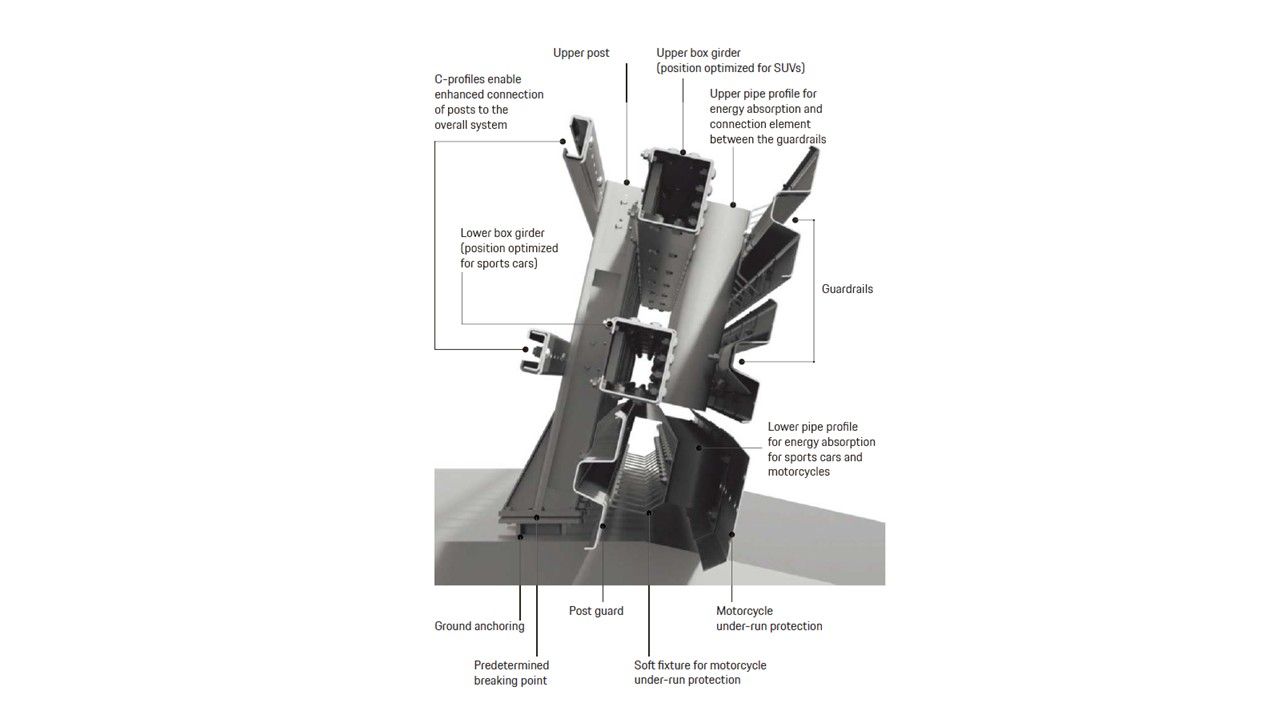
The modernization of the Car Circular Track also included the renovation of the guardrail system. The newly installed solution was specially developed and patented by Porsche Engineering for the high-speed track at Nardò. It consists of two box profiles with three guardrails, including one for motorcycle riders. Deformation elements inside the system ensure that the vehicle is absorbed even at high speeds and the vehicle is smoothly guided back onto the track—with the objective of preventing a spin-out and excessive acceleration forces on the occupants. “Safety was our highest priority. To that end, over one hundred simulations and physical tests were carried out in order to find the best solution,” explains Jaroslav Jirásek, project manager and Senior Manager in the Body and Safety department at Porsche Engineering Services in Prague, whose team carried out the extensive crash calculations. The innovative system also takes account of the changes in vehicle weight: today, SUVs, for example, are significantly heavier while simultaneously reaching high speeds.
Along the external patrol lane above the Car Circular Track, Porsche Engineering executed a third modernization measure: the construction of an IT infrastructure for the future state of the art. A pipe system houses electricity and data cables, with an access shaft every 100 meters. This will allow the installation of radio antennas that will enable tests on the basis of state-of-the-art wireless technologies like 5G. Automobile manufacturers will be able to test and develop connected mobility functions under real conditions. That runs from driver assistance systems to systems for highly automated driving and even autonomous vehicle concepts.

Ready for New Tests: In addition to the Car Circular Track, the 106,000-square-meter Car Dynamic Platform also got a new asphalt surface.
The advantage of having an in-house network: here, individual transmission cells can be switched off for testing purposes or transmission speeds reproducibly modified in order to test the effects of network utilization and malfunctions. The track also allows the use of future wireless transmission standards. The new IT testing capabilities are slated to become available for use in Nardò in 2020.
Porsche Engineering invested 35 million euros in the renovation of the Car Circular Track and the large Car Dynamic Platform. Now they are once again open to customers from the automotive industry year-round—the favorable weather conditions in southern Italy make it possible. In 2018 alone, over 90 different companies came to Apulia, including important manufacturers in the automotive industry. And thanks to the modernization of the test center, at least that many can be expected in the future as well.
Protection at High Speeds
Maximum Safety: The new guardrail system consists of two box profiles with three guardrails, including one for motorcycle riders. Deformation elements inside the system ensure that the vehicle is absorbed even at high speeds and smoothly guided back onto the track. The system also takes account of the changes in vehicle weight.
In Brief
Porsche Engineering has renewed large sections of the driving surface, the Circular Track, and the Car Dynamic Platform, installed a patented guardrail system and outfitted the NTC with a new IT infrastructure equipped for future technologies. But the expansion is far from finished. Further investments in fields such as e-mobility and autonomous driving are in the works.
Info
Text first published in the Porsche Engineering Magazine, issue 2/2019.
Text: Mirko Heinemann
Contributors: Antonio Leuzzi, Matthias Köstner, Jaroslav Jirásek
Photos: Danilo Dom Calogiuri
Copyright: All images, videos, and audio files published in this article are subject to copyright. Reproduction in whole or in part is not permitted without the written consent of Porsche Engineering. Please contact us for further information.
Contact
You have questions or want to learn more? Get in touch with us: info@porsche-engineering.de
Consumption Data
Porsche 911 R
CO₂ emissions (combined): 308 g/km
Fuel consumption:
Urban: 20.1 l/100 km
Highway: 9.3 l/100 km
Combined: 13.3 l/100 km
Efficiency class:
Germany: G
Switzerland: G